

The Prince of Treason, by D. S. Eanes
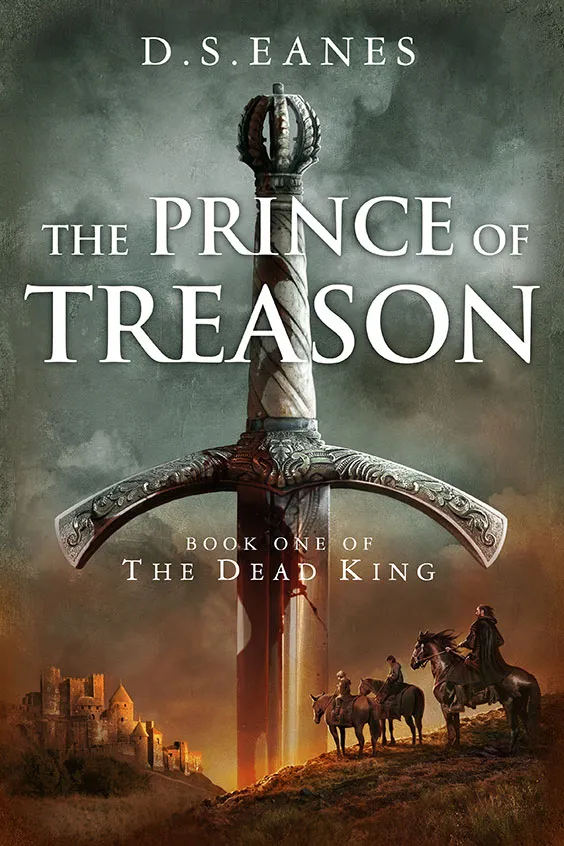
I was provided with a review copy by the author, but all thoughts are my own.
This is one of those rare Grimdark experiences that takes both the grim and the dark as far as they can conceivably go, leaving you in absolute awe of how brutal and ruthless this world and its inhabitants are.
The Prince of Treason is a multi-POV epic following a fairly large cast of characters as they navigate their way through the aftermath of the toppling of the House Edenfield by the objectively evil House Tanis. House Tanis must consolidate their rule, the remnants of Edenfield must flee for their lives, and the distant House Falcos must decide whether to wait for Tanis to invade them next or plot a pre-emptive offensive of their own.
Arguably the main characters here are Robert, the favoured knight of the fallen King Orrin Edenfield, and Gabriel, the titular prince himself. If any of the characters in this book can be said to possess a modicum of decency, it’s Robert, a man who cleaves to his loyalty so fiercely that he abandons his fallen city and dying king to carry out Orrin’s last order: protect Gabriel and see him safely fled from the conflict. Though a stern and sometimes harsh mentor-figure to Gabriel, he is honourable and decent, willing to surrender everything he knows to endure a hardscrabble existence in the wilderness with Gabriel and Konrad, a young peasant boy who accompanies the pair. He’s also on the older side at 39, something I appreciate as a fan of aging protagonists. Not only is Robert gruff and jaded, but he suffers from joint pain and aches in his old scars, granting him the authentic atmosphere of someone who has already lived a hard life, and isn’t earning any soft comforts now as he ages.
Gabriel is an interesting protagonist because you’re pulled between wanting to protect him and wanting to smack him. He’s only a teenager, and has just has his life upended, and the way he struggles to adapt to his new reality is so painfully realistic. Raised a prince, he’s unable to think of himself as anything else, and so has great difficulty adopting the disguise of Robert’s common-born squire. He’s haughty, he takes out his frustration on poor Konrad, and he can be downright unpleasant. And yet, he’s a young boy who’s lost his entire family in one fell swoop, and is now fleeing for his life knowing that his capture will result in heinous torture.
Alongside these two, we’re also provided with a variety of perspectives that broaden our understanding of this world and paint a very detailed tapestry of events. We spend some time with Randall and Byron, the two Tanis princes responsible for toppling the Edenfield dynasty. Though at face value we’re supposed to hate them, and they do display wanton cruelty at times, we also witness their ill-treatment at the hands of their mother, Leona, a woman who definitely won’t be wining any mother of the year awards in this life or the next. Their own brutality is clearly down to how Leona raised them, and is also partly bred from their fear of her. Even when Leona isn’t present, she casts a sinister shadow across the entire book, and her unrivalled ruthlessness influences many of Randall and Byron’s decisions.
I found it impressive how the author is able to make us somewhat sympathetic of such unsympathetic people. Byron, for example, is a devious bastard who has one of the Edenfield princes cruelly executed in front of the man’s wife, a woman Byron himself wishes to sire a child upon. He also then threatens this woman, Aalyiah, into complying with his wishes by promising to murder a child she’s come to care for. By all accounts, we hate Byron, and there’s no redemption for him… until we meet his mother and begin to understand what shaped him. Byron himself does display restraint, and at times there are glimmers of a kinder man in there. He’s probably the character I’m most interested to see progress across the sequels, because I suspect the author is going to do some very interesting things with him.
We also get perspectives from House Falcos, on the other side of the continent from Tanis and Edenfield. Although we chiefly follow common-born archer Edgar, we also get to encounter Kestro, the prince and heir, and his sister Sarah, who is herself a skilled archer. Despite the Falcos’s territory being a marginally nicer place to live, the author doesn’t let up on the grimness here, and the world’s borderline nihilistic atmosphere is continually layered in ways that left me incredibly impressed. For example, Edgar is forced to test his aim against a family of thieves (who, it should be noted, only stole some food because they were starving), and it’s made clear that even something as simple as stealing carries a brutal death sentence. Kestro and Sarah, for their part, were framed as a stark counterpoint to Randall and Byron in that they seemed genuinely interested in protecting their domain and their people. They don’t want to kill for the sake of killing, and don’t revel in suffering, but they also don’t challenge the world’s nastiness, and at times even uphold it in smaller ways (such as Kestro using a prisoner as bait when hunting wolves).
This book reminded me, as I read, of R. Scott Bakker’s the Prince of Nothing series, because of how gloriously and unrelentingly cruel the world and its people are. There was almost a guarantee that any new character we’re introduced to, whether it be ruffians Robert, Gabriel, and Konrad encounter, a lord of a manor Queen Leona stays with, or the group sent to track down Gabriel, would be unceasingly horrible in ways that feel very appropriate for this grim, medieval-adjacent world.
It’s dark, it’s horrible, it’s relentless. And yet, at the core, it’s human. The characters are evil in human ways, and their flaws are deeply human.
And the plot itself is one of those intricate narratives that slowly braids itself through these seemingly disparate characters, drawing them closer together until you can begin to perceive the threads tethering them. The focus on the aftermath of the fall of the House of Edenfield provides us with a central event to focus on, but the story progresses beyond this, laying the foundation for further conflicts centred around the powerful ambition of House Tanis.
This is also extremely polished and well-written, it should be noted. I felt like I was reading something published by one of the Big Five, and because of this, I devoured this book in the span of 2 days because I wanted to keep coming back to it and resented having to put it down.
Given some of the bold narrative directions taken in the latter half of this book, I cannot wait to see where this story will go in the next book!
Create Your Own Website With Webador