

Embers of the Empire, by Logan D. Irons
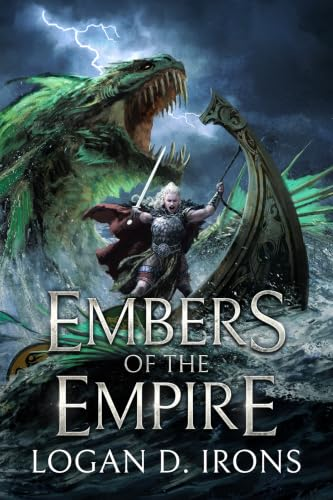
If you’re craving the kind of morally grey, grim, borderline-hopeless epic fantasy I devour by the bookcase-full, then Embers of the Empire is definitely for you!
Taking place 26 years after the titular Lothlian Empire collapsed beneath a devastating attack by the hideous Wyrm Lords, we follow three main characters as they navigate the mess the world has been left in, trying to lead their respective nations and simply survive when everything is against them.
My favourite of the three is Válka, the daughter of the Islekarl of the Storm Isles, an archipelago situated north of Lothlian and therefore mostly removed from the absolute destruction of its toppling. We meet her just as she’s gearing up to fight her older brother to the death after they argue over who should take on the title of commander of their father’s fleet. In the aftermath, Válka is essentially stripped of her rights, betrothed to her uncle by her father (dad of the year, right?) and is given one the chance to partake in one last raid before she commits to the married life she despises.
Válka is fiery and aggressive, a warrior princess dialled up to eleven, and though she’s incredibly combative, she does eventually accept that marrying her uncle (ick) is the best way of keeping her father’s island and her uncle’s island (the two most powerful in the archipelago) united. Even though she hates the idea, she is willing to put the fate of her home first, an admirable loyalty that made her truly compelling to read about. She also never takes any shit lying down, and that right there is true warrior behaviour.
Second is Torbane, formerly a Sworn Bearer, a bodyguard to the daughter of the Lothlian Emperor. We meet him briefly in the first chapter as Lothlian falls, and then again 26 years later, as he scrapes a rough-scrabble living selling salvaged items and doing the odd paid job. Completely defeated by his failure to protect both his royal charge and the empire, he’s got a serious streak of cynical self-hatred, to the point where he makes it clear he doesn’t really care if he lives or dies. I love me a jaded old warrior, and Torbane fits the bill perfectly. It also makes him perfect for descending down into an abandoned mine in search of a bunch of missing miners, an arc which introduces an element of eldritch horror into this book.
Lastly is Garos, a Reaver Laird, once allied to the empire, now chugging along as an autonomous nation that still adheres to old Lothlian traditions. Garos is where the morality comes into play most brutally, because he oversees the Flesh Tithe, which is exactly as it sounds: 1,500 people delivered to the Wyrm Lords who now rule the land of the Lothlian Empire, taken from all over the Reave. What happens to these forced martyrs once they cross into Wyrm territory, no one knows, but it can be assumed they either die or become a part of the eyeless army of people possessed by the wyrms.
Even though he knows sending 1,500 people to their presumed deaths on a regular basis is unethical, he also understands that it’s the only way of maintaining any kind of civilization. He chooses the majority over the minority, condemning 1,500 so that the rest can live. It’s cold, ruthless mathematics, and you can understand why he accepts his lot and chooses not to contest the Wyrm Lords. However, a slave uprising calls his morals into question and has us as the reader, at some points, rooting against him, wishing he’d stand up to the Wyrm Lords and face the consequences. He’s a perfect example of an essentially good person doing bad things for the right reasons.
For the most part, these three arcs are separate, painting a varied tapestry of life after the fall of the Lothlian Empire. I do wish they’d been a bit more interlinked, though I’m sure they’ll cross paths as the series progresses.
The plots for all three are incredibly solid, each with clear motivations, and a clear destination: Válka wants to prove herself worthy to her father, Torbane just wants to keep on moving through life, Garos wants to maintain his grip on the Reaves.
The writing itself is also very punchy and visceral, highlighting brutality, moving at an admirably fast clip. For a considerably short book (only 350 pages), this one packs in a lot of action. At times the writing was a little choppy, with brief scatterings of repetition that threw me off a little, but it was otherwise incredibly easy to get lost in.
Overall, I thoroughly enjoyed my time in the remnants of the Lothlian Empire and look forward to where the series will go next. Based on how the three character arcs leave off in this book, there’s a lot of action yet to come.
Create Your Own Website With Webador