

Ascendant, by Noah Isaacs
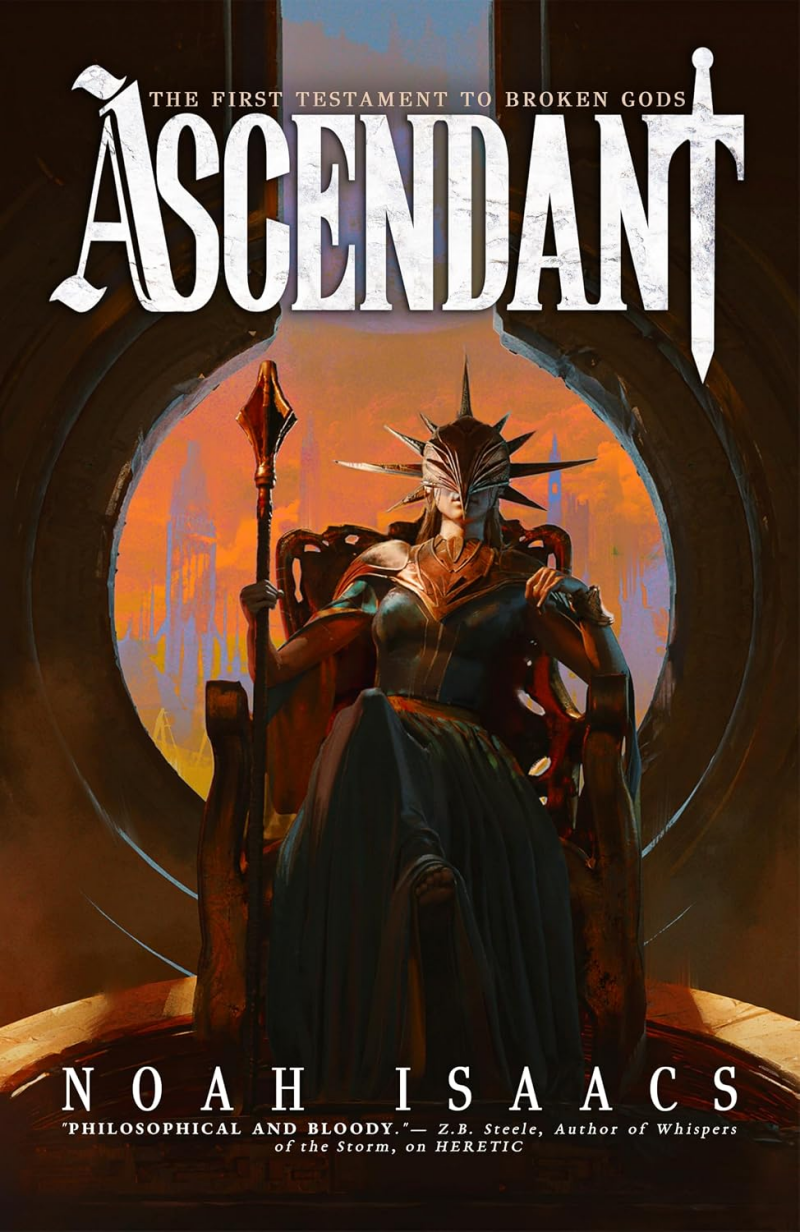
I thoroughly enjoyed Heretic, and the intently developed world being built up within it, so I was very excited to be given the opportunity to ARC read this book, the first in a series.
Ascendant is epic in every way. Epic in scope, in ambition, in worldbuilding, and in stakes. And, suffice to say, it lives up to the gorgeous, alluring enigma that is its eye-catching front cover.
This book is fairly character-led, so I’ll spend a lot of this review talking about the main cast, because they are an engaging bunch worth of investment. Arguably the mainest of the main is Emre Solaire, the youngest son of a shamed house, with but a single feather to his name (in a social system where three feathers is the aristocratic maximum, and one feather is barely better than a commoner). His older three brothers all died in military service to Queen Serilla of Sarcassi, their nation, and Emre shoulders the burden not only of acting as his house’s sole heir, but also in trying to win it prestige once more. His mantra is: “House Solaire dies if I do. So I will not die.” This is quite a lofty ambition to settle upon the conscience of a young man not even twenty, though Emre allows it drive him, motivating him beyond the point of reason. He follows in his brothers’ footsteps by joining the army, serving beneath a tyrannical arsehole and accepting the ill treatment because he hopes, by excelling on his own merit, that he can realise his dream of House Solaire being remembered and revered.
However, an odd voice he attributes to the Dawnmother (this world’s chief deity) begins to whisper of even greater destinies for young Emre, and suddenly his path to prestige becomes a whole lot more complicated. Emre is entirely unsuited to these destinies, but you can’t help but root for him. His desperation to make his brothers’ deaths meaningful and realise the full potential of their family name is an admirable cause, even if Emre is eventually pushed into devious and downright violent actions in its pursuit.
Second is Queen Serilla herself and, like Emre, she is young, unsuited to her role, and desperate to cling on to her title. Originally fourth in line to the throne, historic family tragedies have rendered her the now-queen of Sarcassi, but she is paranoid and untrusting, fearful even when addressing her private council. She acts out of irrational fear, allowing her weaknesses to drive her decisions and often steering her in tyrannical directions. I was captivated by Serilla’s character arc because of this inadvertent tyranny: in trying to uncover a plot to usurp her, she takes drastic action that, when viewed from the outside, is evil and irredeemable. However, because we know how scared Serilla is, how young and out of her depth she truly is, we understand she’s just a struggling young woman surrounded by people willing to take advantage of her power. It’s easy to view her as a villain, but she’s just as much a victim as the people she puts to death.
Orhan is also an interesting character. He’s assigned to be Serilla’s Cognitar (a kind of scholar/advisor) after his previous assignment goes disastrously wrong. Driven by the need to redeem himself for his past mistakes, he applies himself fastidiously to the task of unravelling who’s behind the attempt to usurp Serilla. In his investigation, he’s drawn into rumours of bastard princes and knives in the dark, and finds himself drawing up against the enigmatic Shadowmonger (the shady mastermind who directed assassin Varre in the prequel novella). However, he’s also a very flawed man, rendered reckless and oftentimes blind by his need to prove himself. He follows trails and leads without ascertaining they’re worth pursuing, and acts rashly on new developments before considering where they came from, and whether it’s not some ploy he’s blundering into.
Marcellan is easily the most flamboyant of the five POVs, and the easiest to perhaps misunderstand. A bard in the vein of the Witcher’s Dandelion, he’s a bit of a man whore, happy to foster a reputation for sleeping around, composing songs, and otherwise being quite the fop. However, when Serilla charges him with pursuing a lead in the mystery of a supposed bastard prince who means to oust her, he proves himself more capable than even the reader might credit. Accompanied by a cynical mercenary, Cosimo, and a disdainful religious woman, Mysennia, he sets out on the road from Sarcassi, hoping to prove himself to Queen Serilla. At first, his desire to win her heart might seem like just another notch on his bedpost, but Marcellan is later revealed as having deeper motivations. Beneath his loud and brash exterior is a damaged interior, and one well worth exploring.
The last of the five POVs, Amina, is the one I struggled with the most. I still found her engaging, but her chapters were where the story strayed further into the surreal. As a witch-surgeon, she possesses magical abilities that sometimes make it difficult to tell reality from dreamscape. She’s able to perceive creatures of the Illid (a different plane of existence), and her path seems twined with that of Emre. She’s also Orhan’s niece, and inadvertently privy to information that is now worth her life (or, rather, her death). She doesn’t have as many chapters as the other four, though I appreciated how she was used as a pathway into the more esoteric, magical side of this story and world.
Which brings me neatly onto the matter of the world, and how thoroughly detailed it is. The Lands of the Cycle feels like a living, breathing world steeped in thousands of years of history and brimming with high-stakes conflict. There are multiple nations tangled together, and within these nations exist detailed social classes, interesting governments, and dangerous armies. Sarcassi specifically feels Machiavellian, a worthy successor ot the politicking of A Song of Ice and Fire, with its myriad noble houses, its plots within plots, and its strict social organisation. The idea of the zero—three feather scale, with nobles wearing their feathers on their sallets (helmets) is inspired, and I loved how it drove certain elements of the plot (namely Emre’s desire to earn more feathers).
There’s also the matter of the Wells, which are immense reservoirs of water that sporadically appear across the ages, and which fuel humanity as a whole. People cannot drink water outside of a Well (aside from wine and other minor exceptions), and everyone is given a specific allotment of Wellwater decided by their Wellhearts and portioned out by a Wellwright. These Wells have dictated conflicts over the history of humanity, as nations grapple for control of each Well when it appears. It’s a prime example of an interesting element of worldbuilding carrying immense weight and truly mattering to the plot.
And as for this plot? Well, it kind of has it all. Emre’s is the military aspect, with the big wars, the gritty battles, the boots-in-the-mud perspective. Serilla and Orhan showcase the political machinations. Amina provides the magical backdrop. Marcella injects a touch of worldbuilding as he goes about his travels. There’s the more immediate issue of the attempt on Serilla’s life and the plots surrounding her illegitimate siblings, but there’s also the larger, more looming arcs of Emre’s sinister destiny and the suggestions that this is the end of an age and that with this final Well, the time of plenty is drawing to a close and humanity will enter a dark age.
In all honesty, this book is perfectly suited to fans of fantasy in its myriad flavours. Like epic? It’s got you covered. Enjoy high fantasy? Perfect. Prefer a political edge? That’s all here, too. Love character development? No worries. Would rather a high-stakes plot with the fate of the world in the balance? Absolutely.
Do yourself a favour and check this one out.
Thank you to the author for my ARC copy.
Create Your Own Website With Webador