

The Godsblood Tragedy, by Bill Adams
It took me an embarrassingly long time to start reading this book, but hopefully the fact I blazed through it in about 3 days redeems me XD
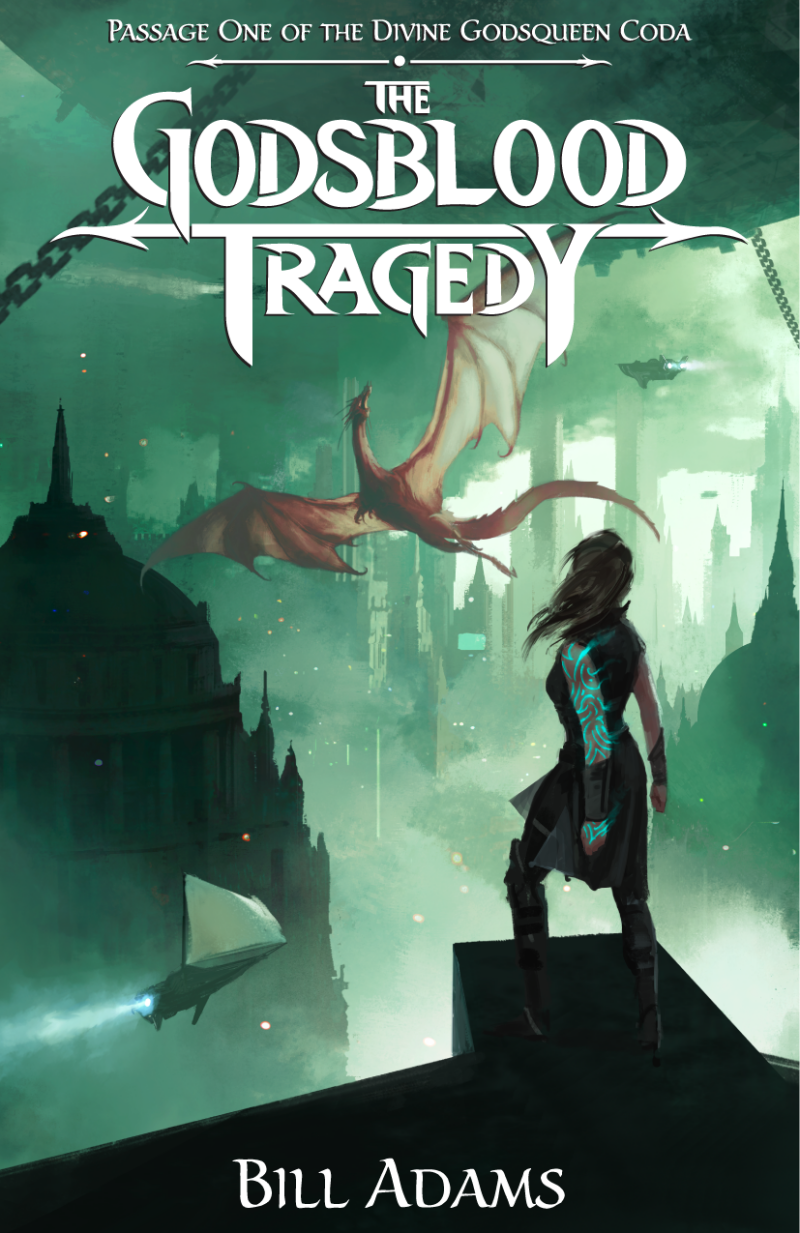
The Godsblood Tragedy is a fantasy of epic proportions, and it’s also insanely unique and creative with its worldbuilding. This isn’t a standard medieval-esque setting, but rather something with a more modern flavour, where characters wield wheellock pistols, the central city thrives through what’s akin to an industrial revolution, and airships powered by magic dominate the sky. I’ve seen Godsblood compared to Mistborn era 1, and though the magic system does evoke that, I’d place it closer to era 2 in terms of setting and vibes.
The main thrust of the plot follows attempts by a rebellious movement to overthrow the tyrannical occupation of the city of Drenth by a resurrected elf referred to as the Fallen, and his sinister sidekick Solanine. The noble scion of Drenth’s murdered ruling house, Emre, oversees these efforts, and through his machinations the other main characters are drawn into his orbit.
We follow four protagonists in total, though the mainest of these is Ashe, a young woman having freshly fled the religious order that raised her in favour of carving her own path in the bustling city of Drenth. Ashe’s path crosses with those of the Fallen and Solanine own vaguely at first, when an attempt by the street gang she joins to rob a nobleman draws the attention of Solanine. Who we at first judge to be a struggling street rat without a birth name, trying to scrabble for her existence, becomes a child seemingly at the centre of a prophecy that impacts not only Drenth, but potentially the entire continent. Ashe is too young and inexperienced for these burdens, but she’s forced to bear them anyway, and she does so with unfailing wit and spite and sarcasm. She truly feels like a feisty youth railing at responsibilities she’s been forcibly saddled with, and can always be relied upon to have some insult or another ready to fire upon whoever is in her way.
Emre, the rebellion’s leader and disaffected scion of Drenth, is the second MC. Believed dead for long years, he’s crafted a persona for himself as the ruling mastermind in the city’s underworld. He has collected around him a circle of trusted friends, though is hard and callus enough to know when the cause is bigger and more important than individual people. Emre is tired of conflict, but strives for victory anyway, willing to sacrifice even himself if it means Drenth can be freed of the Fallen’s clutches. He’s a kind of tragic hero, eager to martyr himself but equally as willing to fight for his life.
Cadrianna serves as a brutal counterpoint to Emre. Yoked beneath the command of the Fallen, Cadrianna is his unwitting champion, killing on his order, working against the rebellion that, in another life, she’d be a crucial part of. She continues to serve the Fallen because she believes she spares her stolen daughter in doing so, a motivation that’s at once understandable, authentic, and tragic. Her character is complicated somewhat by the fact she’s fallen into a twisted kind of hateful love with the Fallen, and she’s constantly pulled between the desire to kill him and her need for his attention. She is, however, incredibly tough in her own way, and certainly not one to be underestimated.
Rounding out the main cast is Lojen, a drakken (think a Skyrim Argonian, or a small, humanoid dragon), the son and heir of a Wardkeeper (an esteemed position within his race). His motivations are slightly more personal, as he sets off on his arc in search of his father’s horns, the ultimate symbol of the Wardkeeper. The fact his father lost his horns to the Fallen brings great shame upon their family, and Lojen and his younger sister have exiled themselves from their homeland in pursuit of these horns. But his mission brings him on a direct collision course with Emre’s rebellion, and Lojen rises to the challenge. There’s an undercurrent of his more selfish aim to reclaim the horns for his family’s sake, but this is balanced by his natural sense of honour.
As for the world itself, it felt suitably massive and complex. We spend most of the time in mist-drenched Drenth, which is itself overshadowed by a massive airship the size of a small city, called Gargantua. This belongs to the Fallen, and is always present as a foreboding prison guard, watching over the city, promising destruction if the Fallen and Solanine desire. The mist itself is also an important aspect of the world, because it’s actually radioactive to citizens, and requires the regular consumption of a substance called parch to counteract the effects. Ashe herself suffers a more terminal form of this mist-sickness, which she calls pulmo, but it provides her a menacing control over the mists themselves.
The magic system is where comparisons to Mistborn are certainly drawn. It’s quite a complex system, relying on the use of runes, Forms, and the act of “burning” aether (this world’s source of magic) to achieve a specific effect. The aether itself originates from two great crystals, and the art of channelling the aether is anchored to one of the Pentax, the pantheon of gods. Aether can also be condensed into aethercite, which serves as fuel and powers industry. Overall, I really liked this system, because it was braided into the plot and worldbuilding in an irreversible way. Drenth is the way it is because of magic, after all. Magic is intrinsic, not just a bit of set dressing.
One thing that caught me off guard about this book was the pacing, and I mean that in a mostly good way. The first half builds up the conflict, moves the characters into their places, and allows the machinations and politics to unfold. The second half, however, is then a series of breakneck action sequences as Emre’s rebellious plots unfold and Ashe’s part in everything is made clearer. From the moment Emre and company disguise their way aboard Gargantua for a party thrown in honour of the anniversary of the Fallen claiming Drenth until the penultimate chapter, the characters are in constant motion, either fleeing trouble, engaging in fights, or being gunned down.
I enjoyed this acceleration in the pacing because it made the book very difficult to put down. However, it does have the slight side-effect of not providing much time between action beats for plot twists, character deaths, and reunions to fully resonate with the reader. There were two acts of massive betrayal, one of which hits harder than the other because the traitor was a perceived romantic interest, that didn’t impact me as hard as they could because we hadn’t really had time to get to know the characters and their dynamics pre-betrayal.
That’s a minor gripe, though, because otherwise the faster-paced plotting of the section half serves this book incredibly well. Events build rapidly up to a climax to explosive effect.
Overall, I thoroughly enjoyed my time with this book, and have promptly added book 2 to my TBR. If you like your fantasy epic, your worldbuilding inventive, your characters flawed but well-meaning, and your stakes large, then this should certainly be on your radar. This is what fantasy should be doing: testing the boundaries and offering something different and creative.
Create Your Own Website With Webador