

The Burning Grasses, by Chantelle Fourie
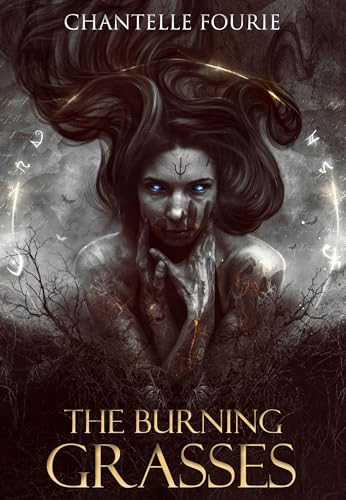
This is Grimdark at its most complex darkest, and I had an absolutely incredible time with this book!
The Clyvendi clan has only known peace for a short time before impending war with the Askari clan draws their army into the desert, where the soldiers suffer horrible nightmares every night and the enemy refuses to show themselves. Lim, a gifted mage of the green fire, and Yulta, the clan’s Reader, contend not only with the fracturing of the army’s morale as captains begin questioning the conflict, but also Lim’s unusually powerful magic and the strange dreams he has ever night of meeting a woman in a forest.
Though we follow multiple characters as they navigate this surreal conflict with the destructive Askari tribe, Limneth and Yulta are our key players here, and they best exemplify the brand of moral complexity and authentic grit that this book thrives on. Via the novel’s three different arcs, we experience the unique privilege of following Lim and Yulta both in the present day, as events come to a bloody climax, and during their formative years, when their paths first cross and their destinies being to align.
This dual timeline framework does absolute wonders for the story, because we get to watch a younger Lim and Yulta grow at the same time as witnessing how this growth plays out in the present day, when they are both in their mid-twenties and coming fully into their magical abilities. It was thoroughly compelling, watching a young and innocent Lim be taken under Yulta’s more experienced wing and slot himself into palace life alongside other magic users. And it was equally compelling to see him years later, assured in his power, harbouring complex emotional baggage regarding his relationship with Yulta.
Individually, Lim and Yulta are very flawed, very complex people. Yulta especially is depicted doing some very nasty things on-page in the name of furthering her power, and we’re never quite supposed to sympathise with her. She’s someone you admire from afar, but would never want to get too close to lest she murder you for your blood to use in her rituals. I really liked the power she exuded, and how unsettled she seemed to make everyone around her (everyone apart from Lim, of course).
Lim also possesses a destructive and dangerous aura, though he’s managed to win the respect of his fellows by becoming leader of the green fire contingent of the Clyvendi clan’s army. He’s a grim and brooding presence, and at times even Yulta seems to struggle to comprehend him. His ethereal connection to a woman he meets in his dreams, bolstered by the sheer potency of his magic, make him something of a demigod, untouchable and unknowable to friend and foe alike.
The third of the main characters is Danik, a young girl stolen away by the Askari Brotherhood, and who lives 300 years before the time of Lim and Yulta. Forced to fend for herself on the streets from a young age, she’s eventually plucked up first by a brothel owner, and then by the Brotherhood, who decree that her affinity for the green fire marks her as the future bride for the Nyen Geh, their prophesised god. Over the years of her adolescence and young adulthood, Danik trains with this Brotherhood, facing harsh punishments for minor slip-ups, being relentlessly bullied by some of the other women there (called sawahs), and honing herself into a razored weapon. One example of a training method the Brotherhood uses to enforce focus and firmness in the sawahs: having them balance atop poles over a lake for five hours straight.
Although I truly loved Danik’s arc and think it might even be my favourite of the three timelines, I did sometimes wonder what her connection to Lim and Yulta was. Even after it was made more obvious (no details to avoid spoilers), the resolution to Danik’s arc did leave me with more questions than answers. She felt almost entirely removed from the other two arcs, though this might be something that’s developed more in later books.
There was also a slew of engaging secondary characters. Nagesh, Yulta’s half-brother, lover, and commander of the Clyvendi clan, harbours an unhealthy need to possess Yulta and have her love to himself. Izyan, captain of the blue fire, is religiously devout to the extreme, his obsession with the gods a stark counterpoint to Nagesh’s own obsession. Nia, a sawah who befriends Danik during their time training with the Brotherhood. Arweshi, a fellow sawah and leader of the girls who bully Danik, but who constantly feels the need to prove herself and be the best. Adnan, Izyan’s second-in-command who quietly questions his captain’s devotion and who endeavours to protect his younger sister.
Honestly, there wasn’t a single character I found to be anything other than authentic, compelling, and developed.
The magic system feeds into the surreal nature of the entire narrative. At its core, it’s split into three sections, which are represented by a colour of fire: the blue fire (skin-changers and the mages who oversee them), the yellow fire (who derive their magic from physical relics), and most importantly, the green fire (also called Scavengers, they feed off the magical energy ejected by other mages). We experience the green fire the most because that’s the gift Lim possesses. There’s an aura of mystique surrounding the magic system that fuels the mysticism, though the rules were contextually well explained and it was always clear what was and wasn’t possible with each variant of magic. We are also afforded glimpses of magic outside the Clyvendi tribe, such as the Wildling elemental magic, specifically the cannibalistic Kori tribe which practises ice magic.
On top of this, there’s also the titular burning grasses itself, which is framed as either being a sort of purgatory, or simply a different plane of existence, depending on who you ask. It’s very much tied to this world’s gods, and exists as an esoteric location the main characters are drawn to. I love how enigmatic this locale actually is, as there are times in the book where the smell of burning grass is used to indicate a character is there with few other hints. It awards the story an element of fluidity, as if this surreal world exists so close to the physical world that falling from one to the other is so easy as to be almost unnoticeable.
As for the writing style: it’s brutal and visceral and perfectly paired with the content of the narrative itself. It’s also incredibly polished, to the point where I constantly found myself wholly embedded in the story and unable to tear myself away. It’s one of those “one more chapter” rabbit holes fantastic books drag you into.
One thing to note about this book: it is absolutely unflinching when it comes to violence and more taboo content. It will look you in the eye as it holds a rusty knife to all that you love and slice into the jugular without flinching, and I both love and respect it for that. There’s liberal use of blood magic, some of which involves on-page cannibalism and sexual assault, as well as a particularly gnarly scene where Yulta has Lim remove the bones from one of her hands so she can replace them with old bones taken from a crypt, which will heighten her existing power. This scene had me sitting there with my mouth open in absolute awe of Yulta’s dedication to her craft, and my own hand started aching in sympathy.
Overall, this is a Grimdark fantasy that wears its label proudly and continues to prove why this subgenre is so unmatched. The Burning Grasses has gotten me excited for the rest of the author’s books.
Create Your Own Website With Webador