

Stone and Flesh, by Tamara S. Harker
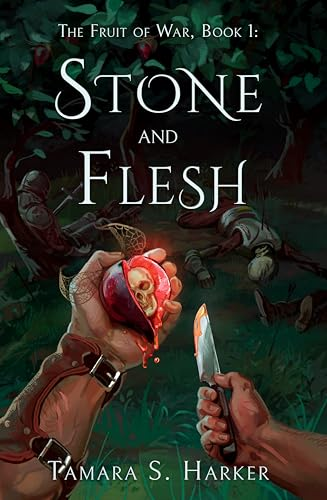
This book is truly magnificent. There is no other word for it, and it’s frankly criminal that it currently has fewer than 20 ratings on Goodreads.
I knew going in that this was going to be an exceptional fantasy epic because of how much I enjoyed the prequel novella, The Hidden. The world hinted at in that novella was huge, detailed, and complex, and Stone and Flesh pays off on those promises a thousandfold.
I don’t think I’ve ever read a book that world builds quite as adeptly as this one, and I’ll be so bold as to say even Sanderson doesn’t do it quite as well as this. Ícalar is a land that lives and breathes, that is saturated with history, that has been rubbed raw by conflict. The world itself feels like a nuanced character, and the details of it are so effortlessly woven into the fabric of the story that you feel like you’re traversing the landscape alongside the characters. Even the smallest details, such as the clothes people wear and the flowers they buy for certain occasions, are treated with as much care and reverence as Harker herself treats her readers. Because this book doesn’t hold your hand, but rather trusts you to follow along with the story without the need to repeat worldbuilding details or overexplain anything. I think it’s really special when a book as large and broad as this one enfolds the reader into its embrace and has faith in them to understand and comprehend. And if you should happen to forget an important worldbuilding snippet? Well, then you can rely on context clues and subtle descriptions as reminders, or else consult the detailed glossary at the back of the book.
Aside from the sheer scope of the worldbuilding, another highlight for me were the characters and their group dynamic. This plays a little on the “ragtag bunch of misfits” trope (my favourite trope, coincidentally) in that a group of scattered people are drawn together by the central plot and forced to cooperate in the face of life-threatening dilemmas. The individuals involved don’t start out as friends, but through their many ordeals and brushes with death, a group bond reminiscent of a found family develops, and you start to think that maybe this world is in good hands after all.
Arguably the main character is Fîeron, this world’s equivalent of a magical coroner, whose usual tasks see him guiding the souls of the recently departed towards their afterlife and dealing with the grief the departed’s relatives might harbour. His latest passenger is the soul of a renowned war hero, a man credited with a large role in the War of the Six, a conflict that tore the land apart and resulted in a devastating plague being unleashed more than a decade ago. This is no simple job, however, because the war hero’s soul imparts a message to Fîeron: within his corpse is hidden a vial that contains five stones of a now-extinct fruit whose existence caused the War in the first place. And Fîeron is not the only person who now knows where those stones are.
And so explodes our plot to devastating effect, forcing Fîeron to flee for his life. His path collides first with those of Devatska and her granddaughter Kōtia, and shortly after with Aramastus, young Kōtia’s mentor in the military order she’s training within. Devatska served as a sort of military advisor during the War of the Six, but has since disappeared into self-imposed anonymity following the fallout of the deaths of her husband and all of her children. Wishing for a quiet, simple life raising her granddaughter, Devatska is begrudgingly drawn into Fîeron’s plight, though she grumbles the whole way through. Devatska is incredibly relatable, and it’s so refreshing for an older character to be so heavily involved not just in the plot, but in the action sequences. Devatska isn’t there to increase the average age of the main group, but rather to help drive the plot forward and to strategize like she used to in her glory days.
Kōtia, at only sixteen, is headstrong and borderline reckless, and yet possesses the immovable integrity of the truly loyal. Abandoning her chance to graduate in order to help her grandmother, she’s far less reluctant to embark on this quest than Devatska. However, despite her age, there’s a core of cold, hard iron to this teenager, and it was fun watching her butt heads with her equally stubborn grandmother.
Aramastus, who also fought in the War, is a faun, one of this world’s non-human races. Jaded by his experiences, and nursing the loss of is wife and daughter, he possesses Devatska’s cool head for planning and Kōtia’s brazen fury in a physical fight. I was fascinated by his character because he’s cynical and brooding without being outright nihilistic, and without steering too far into archetypal territory. He’s a man who’s lost everything, yes, but there’s so much more ot him than that. Rather than wallow, he places himself in harm’s way and risks his life and his career for his young charge and for Devatska, a woman he considers almost a mother.
The other two main members of this crew, Unliore and Kaavius, remain largely separate for quite a lot of the book, though the multi-POV nature of Stone and Flesh means we get to follow their trials as they too are drawn into the conflict kickstarted by Fîeron discovering the extinct fruit-stones. They are both also non-human, from two different races that share a deep connection with this world’s inherent magic. Unliore and Kaavius are old friends, and it’s yet another dose of refreshing that this book offers in the form of a platonic male-female friendship. Unliore and Kaavius care deeply for one another, but they don’t harbour any romantic feelings towards each other. Their bond is nuanced and authentic, and there was one interaction whether they have a blazing row that felt particularly cathartic to read.
There is also an expansive cast of secondary characters, all of whom I felt were welcome additions to the cast and who each served a purpose. Whether that be Xa’aroch, the demonic entity who serves as the book’s antagonist, Fhalz, the plucky young friend of Kōtia, or Luiran, the nobleman Unliore works for, they each brought something new and engaging to the narrative. I honestly don’t think there was a single character I was uninterested in because they all carried their weight and earned their place.
The magic system at play here is also very intriguing. It’s fairly esoteric and natural, with its foundation being that everything organic is made of Éga, and that this surreal substance can be channelled. The magic system itself is split into three main subsections: Aré (used for things like healing, necromancy, and carrying souls the way Fîeron does), Rel (fire and heat), and Üon (ice, cold, and illusions). Each use of magic has its own place within society, with the most obvious example of this being the Shepherds of Leaving, the Order to which Fîeron belongs, which is responsible for using Aré magic to transport and release the souls of the newly dead. The magic system possesses enough rules to lend it legitimacy, but not so many that we become bogged down in the details. It’s the perfect balance, and a great use of an ethereal magic system.
As for the plot, I was enthralled by the way it unfolded. This being a huge world, the build-up was necessarily detailed and slower-paced, with a fair bit of time in the first half spent lining characters up and ensuring they crossed paths. This was to the narrative’s benefit, as it allows us time to comprehend the state of the world and understand why the reemergence of these fabled stones is truly so devastating. But then, as the stakes climb, as the main company grows, and as the true threat makes itself known, the pace ramps up until the final 100-ish pages felt like the most exciting of rollercoasters.
It was also always very clear where the plot was heading, what the goal was, and what the stakes were. The presence of the stones and the initial need to verify their authenticity at first evokes the carrying of the One Ring in LOtR, and the narrative backstory of the War of the Six and how the stones were involved made it abundantly clear how dangerous these five simple objects could be if given to someone with the power and moral bankruptcy to abuse them.
I also apprecaite how this book manages to tie up some of its main threads at the same time as setting the stage for the sequel in a way that doesn’t feel like sequel-baiting at all. This very much feels like the first act of a grand story, where the curtains have closed on some satisfying resolution but we know that, as soon as that curtain lifts again, we’ve got many exciting adventures to look forward to.
I for one cannot wait to see what the successive books in this series have in store. I had a difficult time finishing this book purely because I wasn’t ready to leave this world yet.
Create Your Own Website With Webador